| |  | |  |
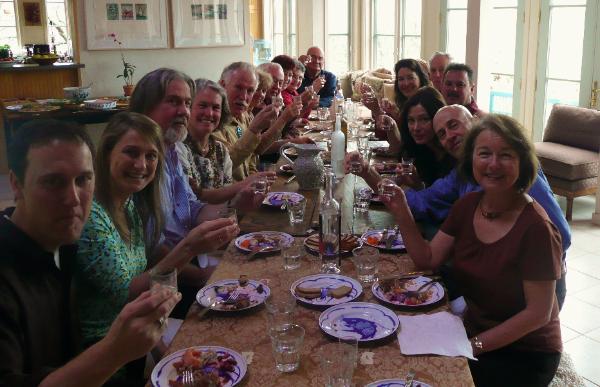
| To match a Russian Feast... The Theory of Russian Feasting Teoria Ruskova Praznitsva in older christian times, there were about twelve feasting days a year, so let's break-bread and recapture ourselves - I n g r e d i e n t s - The story that I tell myself is that I am lucky. And as such, it comes true. I'm not saying that I haven't had terrible things happen, but the resolution of those terrible things brings a farther outlook, and greater peace than I had before. Yes! it is a crucible, or let's call it a boiling pot, or better yet, a stewing pot, or even better yet, a fermenting vessel; ( s e e h o w t h e s t o r y o f l u c k p r o g r e s s e s ? ) but when that fermentation of the negative, or the positive, has been accomplished, one can be more free and more capable to LOVE. Celebrating that process, luck and love, is the theory of Russian feasting. Good theory easily finds application. And the application at hand is why Ahh Winery is going out of its way to bring you, our esteemed Wine Club members, a happening that is not even remotely a 'wine and food matching' experience. Rather it is a Russian Feast. So why would we do something that doesn't feature wine? Beacuse there are elements to the enjoyment of wine that are closely related: some of them exagerated and some of them subdued. And the experience of the Russian Feast helps us understand an element of fellowship and sensuality that we should have at our finger tips when we enjoy wine. First let me explain a few of the confounding elements: when most Americans drink spirits, we do it on an empty stomach. And certaintly not always, but sometimes, things can get out of hand. This is because the element of alcohol can overtake and diminish the wisdom of the nervous system. Wisdom, and accordingly, judgement is compromised because of the rapid uptake of alcohol. If the empty-stomach thing is not the cultural case, then other things are possible. The nervous system can keep up with the changes of conciousness. This is the difference between just drinking and the Russian Feast. So there is a way that the Russians have developed of consuming spirits that is quite different than the typical American experience. And it has a protocol. As with any protocol, it is better to understand it and abide by it, and then once understood and experienced, the protcol can loosen up so it doesn't become a silly rule book. What I would like to do is to introduce the protocol of Russian Feasting as seen through the eyes of a non-Russian, but an experienced feaster. This luck comes through my beloved association with the Zaharoff family. How we met is another story. So... The first step is to gather a good group of people together. This does not mean that everyone has the same political, religious, or sensual outlook; it means they are the right group because they have a story to tell and they are genuinely interested in hearing the story of another person. So given that they are good, but diverse... it is going to be a little bit like herding cats. You have to get them to the same place at the same time. The reason for this is the same in Appalachia as it is in Russia. In both places people are better at eating and drinking than small-talk. The feast starts by arriving, filling your plate, and sitting at the long table. There are no little finger foods, because all the food must be blessed before the eating and toasting begins. The social signing-on occurs at the table with the toasts. And about the table. Most Russians have an expansive nature, but many of them come from a modest background. So having a big crew over to your house takes a little creative adaption. You try to get everybody at the same table, the best you can. The typical way to do this is to just squeeze in. Seating is cozy at a Russian table. If you want to get up, at least two or three people on either side of you need to make adjustments such that you can get out. It's like a diamond lane on a California freeway, where you can get out only every so often, there is a similarity in that you need to plan your exit. This seating style is a departure from the American no-touching, but it suits me just fine. Once the appetizer or first course plates are filled, and the food is blessed, then the toasting begins. Alla, my adopted Russian mother, says that it is best if we have 3 toasts in the first 3 minutes. I can't say we have ever accomplished that, but I can say, every feast we give it a darn good try. There is a great symbiosis between the food and the toasting. This is one of the Russian cultural perfections: the food is juicy, not too too rich, which encourages lots of eating, which mitigates the vodka consumption. And that is my first point of protocol: If you stop eating, stop drinking. Yes, I graduated from the university of hard-knocks on this one. We had a blini dinner, where the food is composed of specialized buckwheat pancakes, soaked in butter, and rolled up with fish inside. I couldn't handle the butter, so I stopped eating, but kept drinking, and yes, personal disaster ensued. I didn't do harm to others, unless you include myself as an 'other', and yes I was having an out-of-body experience, so yes, I did harm to an 'other'. So much for protocol and the deep background of its formation. The real beauty of a Russian Feast is you get to know people like you have never known them before. And then with that knowing, and a blessed sort of energy and spirit, then a bonding can occur, God willing. A bonding that lets you know you can always have help bestowed to you by that other person. Help, if you can ask for it; which is one of the most confounding acts of humanity. Why is it so hard to ask for help when we really need it? We can do it all day long when we don't really need the help, but when the cards are down, that is when it becomes confounding. Well, I can say that the Russian Feast is one of those ways out of the confoundingness. I can't say it will solve the problems of our human-ness, but.... I can say it's a hoot. Next Page |